For your team
Separate observations from hunches in competitor research
Competitor research is easier to revisit when the page’s contents and your interpretation stay separate. Save public-page URLs in linqlo and use each memo for a check date, an observation, a hypothesis, and the questions you have not answered.

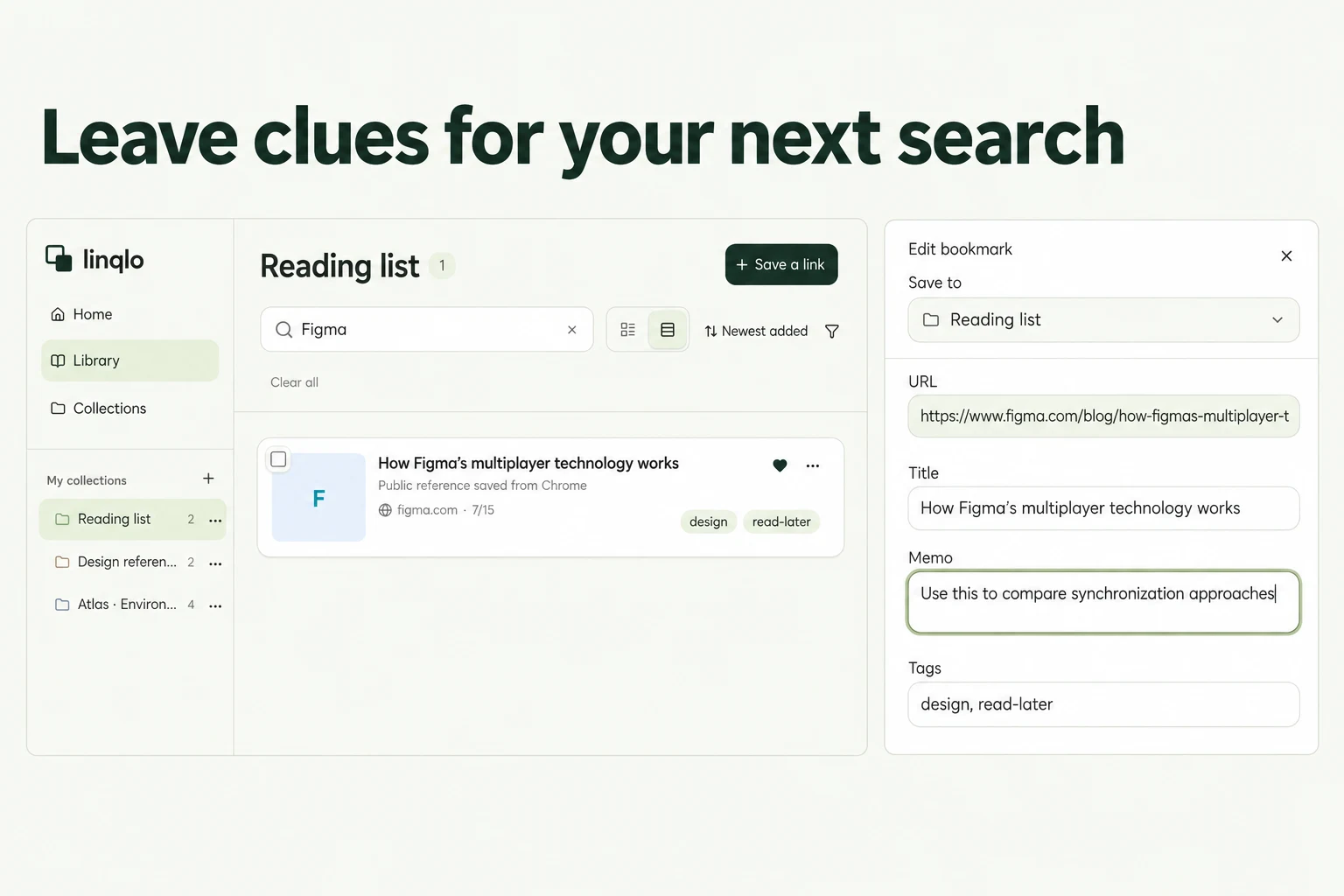
AI-generated illustration, not a comparison of real services or the linqlo interface.
Make “that seemed clear” useful later
Notes such as “A is simple” or “B is for large companies” do not explain what prompted the impression. Someone returning to the research has to reconstruct it, and an interpretation can gradually become an accepted fact.
Suppose “for large companies” came from a headline about managing multiple locations. Record the headline’s subject first. It does not establish the service’s actual customer sizes or sales criteria. “The page may be addressing multi-location operators” belongs on a separate line as a hypothesis.
This distinction helps another reader tell which points they can verify on the page and which interpretations remain open to discussion.
Ask the same three questions of three sites
Our example uses public introduction pages for three fictional booking services, A, B, and C. It does not evaluate real products. The research question is: “How should our own introduction page explain who it is for?”
Look at the intended audience, the opening message, and the entry point for getting started. Trying to investigate every feature, price, and customer story would broaden the assignment unnecessarily.
| Fictional page | What the page shows | What this does not establish |
|---|---|---|
| A | An opening reference to independently run classes | Whether all customers are sole proprietors |
| B | A multi-location message leading to a consultation form | Whether smaller businesses can use the service |
| C | Several use cases leading to a product walkthrough | Which use case is the most common |
The services and page contents are fictional. This is not an automatically generated comparison in linqlo.
When you cannot find something, write “Not found on this page.” That is more precise than “The feature does not exist.” Another page or the service’s terms may address it.
Write a research memo beside the URL
Create “Booking services · Introduction pages” in an existing, appropriate team workspace. Save the public pages and use a title such as “A | How the audience is described” to identify the question behind each reference.
Save the URL first, then edit the bookmark, or choose “Detailed entry” while adding it. In “Memo,” write:
Checked: 2026-10-03 (fictional example)
Observation: The opening addresses independently run classes; the main entry point is a product walkthrough
Hypothesis: The structure may help a person managing bookings alone picture how they would use it
Unknown: Actual customer mix, applicable plan, and conditions for the walkthrough
Relevant to our question: Describing a specific audience at the start of the page
Source location: Opening section of the saved public introduction page
Keep observations concrete. For a hypothesis, retain enough context to explain why you considered it. You do not need to reproduce long passages: a short paraphrase and a clear source location let you return to the original.
If you add tags, use the questions you are investigating, such as “Audience” or “Getting started.” These explain why a link is useful without turning a complex assessment into a one-word ranking.

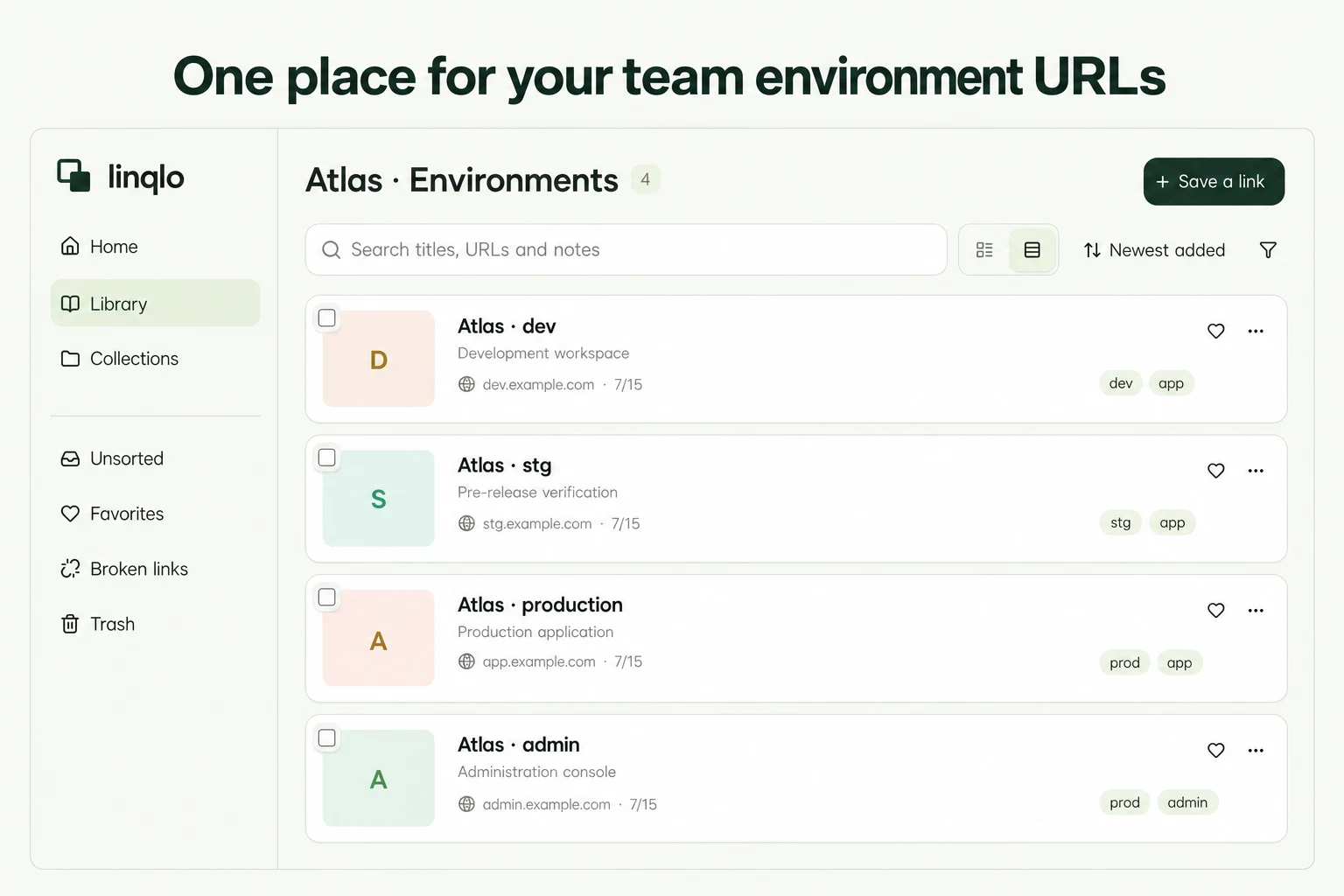
AI-generated conceptual illustration, not an automatic site-analysis or change-detection screen.
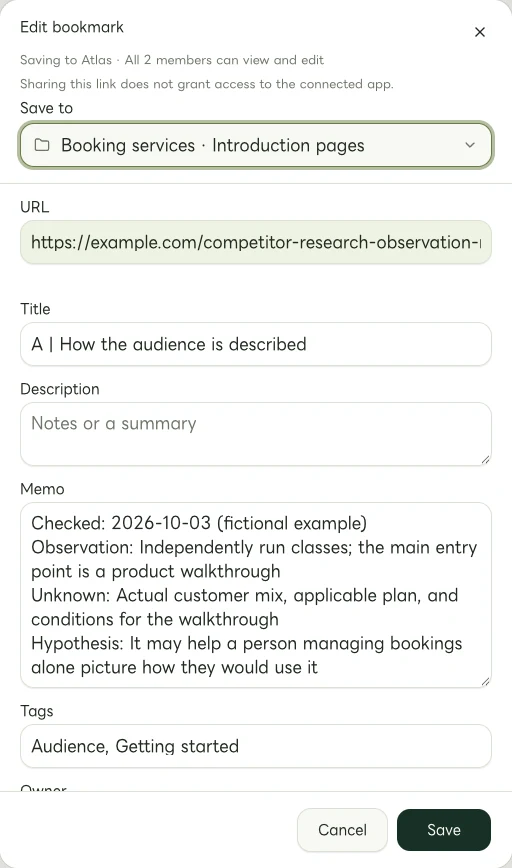
Actual Web edit dialog showing a fictional example.com link. The memo and tags are examples of manually entered information.
When you revisit a page, date what you actually checked
Read the previous memo, then inspect the current page. If the entry point has changed, manually add a dated observation: “Previously led to a walkthrough; this check shows a consultation route.” You can replace the older note if its history is no longer useful.
Do not give untouched information a new verification date. If you checked only the opening section, say so. This workflow maintains reference URLs and your own observations; it should not be treated as an automatic record of page changes or their timing.
Set a small stopping point
For this assignment, three observations and one useful question for your own writing may be enough. “Should we describe the audience by job type or by use case?” is a concrete discussion to take forward. Another ten websites may not help resolve it.
If an unknown point affects the conclusion, verify it in public official material or leave the conclusion open. Do not fill gaps with unsupported revenue, customer counts, or guesses about private information.
For your first reference, look at an impression you have written and ask, “Which part of the page made me think that?” Adding that answer turns a fleeting reaction into research you can use again.
Related guides
Put the guide into practice.
Shared workspaces are included in the paid Team plan, from two seats.
See team plans and pricing