For you
Save your sources with the claim they need to support
When collecting sources for an article, save what each URL is meant to support. Use a linqlo memo to keep the source's content separate from your own interpretation. That makes it easier to return to the right passage when a sentence in your draft needs checking.
Generated illustration using books and a notebook to represent writing with sources. It does not depict an actual study or paper.
Avoid the pause that starts with “Where did I read that?”
A point seemed clear during research. Later, you begin to write it and cannot remember whether it came from the original research or someone else's explanation. A list of URLs helps only so much if you cannot connect them to the sentence you are trying to write.
A useful source note preserves both the question a document can answer and the limits of your reading. You can record that before deciding whether the material belongs in the final article.
Separate sources by the job they do
Imagine preparing an internal article about ways of working. The documents and draft in this example are hypothetical; they do not represent actual research findings.
The official study helps you check who was included, when the work was done, and how the questions were framed. The publisher's announcement provides context for the release. An explanatory article may help you identify useful questions, but its interpretation needs to stay distinct from the original document.
Three links on the same topic can be useful when they perform different jobs. But three explanations that all refer to one study do not necessarily provide three independent pieces of evidence. Check their references and save the original material separately when needed.
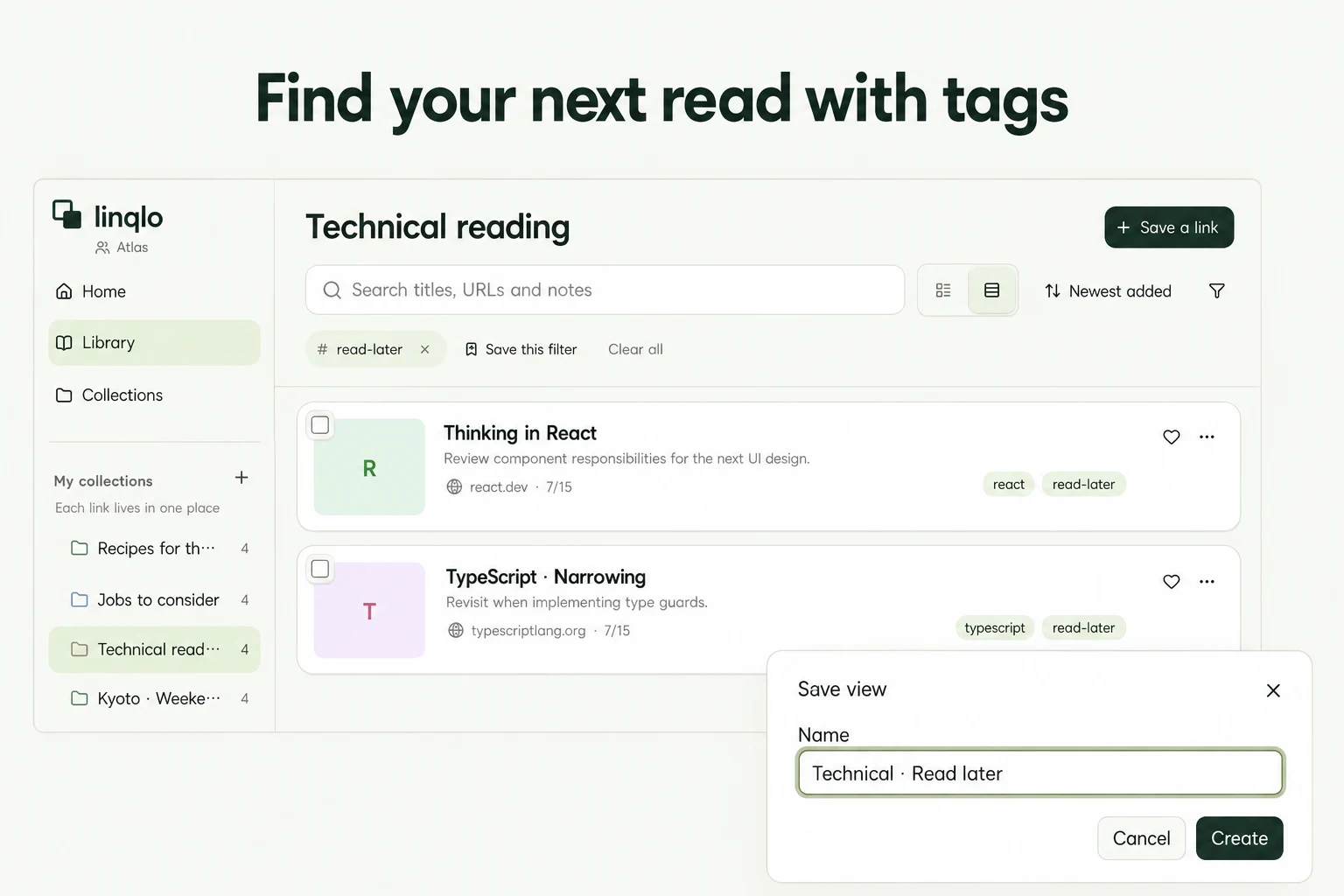
Create a “Workplace article: sources” collection in linqlo. You might manually tag links “study,” “announcement,” and “commentary” to make those roles easier to recognize. These are labels you choose for the writing project.
Four things to put in the memo
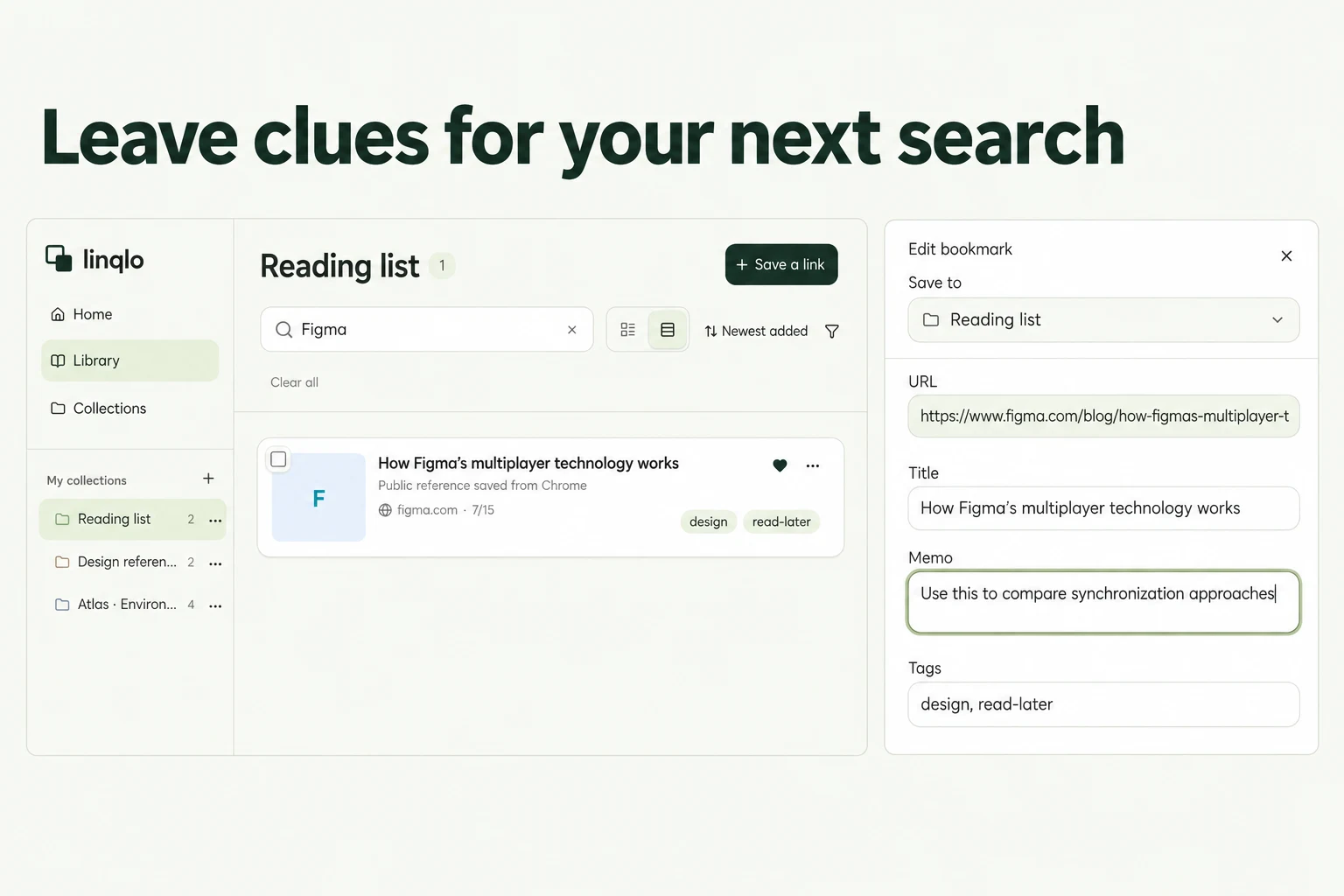
After saving a URL, edit its “Memo” field. The note does not need to become a full reading journal. It needs enough detail to help you return to the relevant part.
1. The point to support. “Ways of working” is too broad. “Check how this study defines its participants” gives the source a question it can actually answer.
2. The source and location. Record the publisher, document title, displayed publication or update date, and relevant heading. For a PDF, note a location you can find again, such as the document's own page number. Do not invent a missing date; write that it has not been confirmed.
3. What the source says. Label a summary as your summary. If you retain a short passage as a quotation candidate, mark its boundaries clearly and leave yourself a reminder to check it against the original.
4. Your interpretation and open questions. Put “It is not yet clear whether this applies to our workplace” on a separate line from the source's findings. The distinction will matter when you begin drafting.
For the fictional study, a preliminary note might read:
Point to support: the definition of the study population. Source and location: verify publisher and publication date on the original page; see the methods section. Source summary: complete after checking the participants and conditions. My interpretation / open question: do not yet assume this describes our workplace.
Leaving a field explicitly unconfirmed is more useful than filling it from an impression you have not checked.
Generated illustration using a botanical image and string to connect a selected detail to its source. It does not depict automated fact-checking.
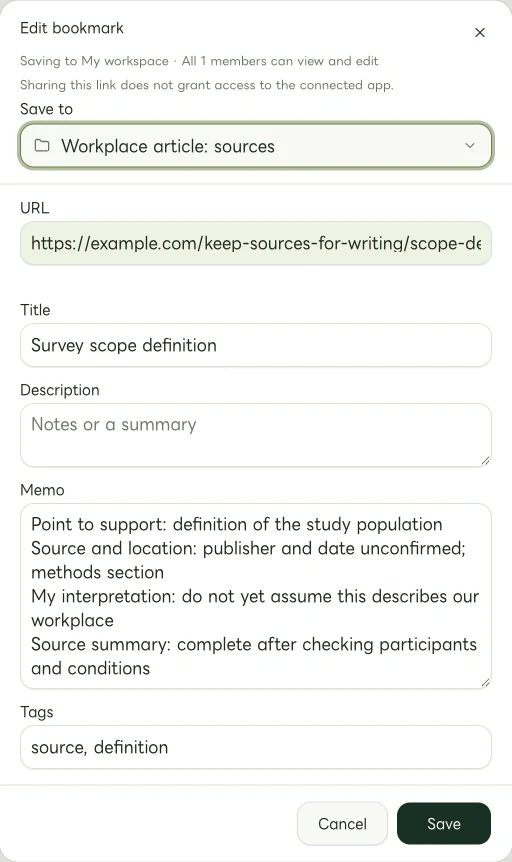
Actual Web edit dialog showing a fictional example.com link. The memo and tags are examples of manually entered information.
Work back from the sentence in your draft
When you start writing, look at the claim you want to make rather than following the order in which you saved the links. Ask which part of that sentence the source supports.
For a statement about who a study included, return to the methods section. For a statement about how people received a finding, check whose view you are describing. If your sentence extends beyond the evidence, narrow it or turn the gap into a question for further research.
A manually applied “check-needed” tag can help you find unresolved sources. Update the memo and remove the tag when the question is settled. The useful part is the written question; a status label alone will not explain what remains uncertain.
Check against the original before publication
Open the original material for the final review. If you use a number, check its unit, population, period, and comparison conditions. Check a proposed quotation against the wording and surrounding context, then follow the publication's citation and style requirements.
A publication date and the date you accessed a source are different facts. Check that you have not moved to a revised page or another edition without noticing. If a page is no longer accessible, do not treat a short memo as a verified substitute. Find a source you can check or reconsider the claim.
This workflow creates a path between a draft and its references. Each time you save a source, add one line saying which question it answers. That line gives you a useful starting point both while writing and when checking the finished article.
Related guides
Put the guide into practice.
Create a free account to get started. No credit card needed.
Start organizing for free