For you
Turn conference links into one thing to try next
Conference links become more useful when you separate what a speaker explained from what you want to try. Save the public resources in linqlo, add your own question, and choose one small experiment for the following week.
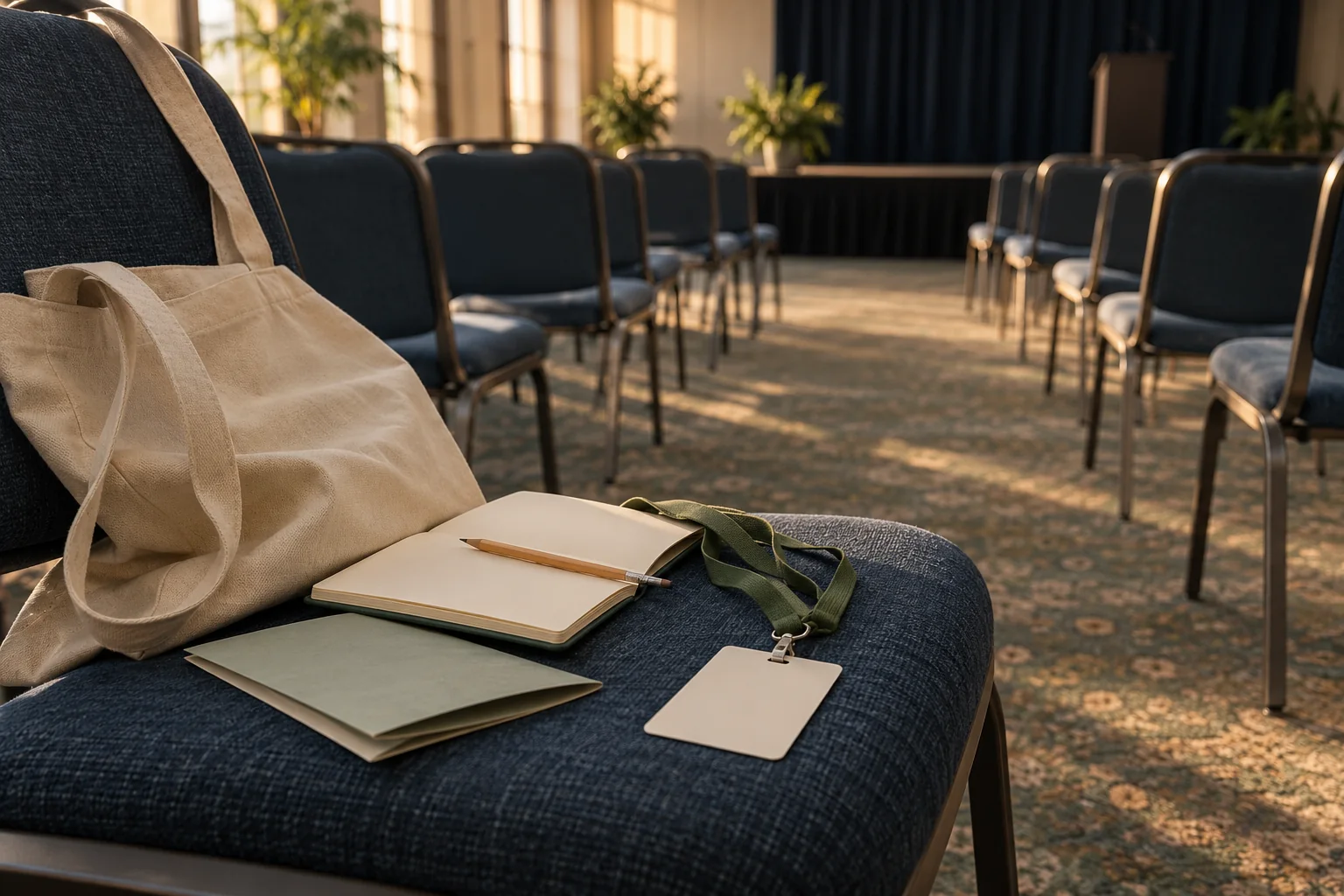
AI-generated illustration. It does not depict a real event or the linqlo interface.
That evening, write down the question you still remember
After four sessions, rereading every slide deck is a lot to ask of a tired evening. Start with the question that caught your attention: “Would this work for a smaller team?” or “Could this help with our current review process?” One line is enough to preserve a useful connection.
This guide uses a fictional event, “Autumn Development Day,” with sessions on testing, interface design, operations, and team communication. The event, session content, and suggested experiment are illustrative, not a report of anyone’s attendance.
Create a collection called “Autumn Development Day · Follow-up” and save the official program URL. If the slides are not public yet, note the session title and “Slides not published.” You can stop there for now. If you are unsure of a speaker’s exact words, label your note as your understanding rather than putting a remembered phrase in quotation marks.
Give each session a clear starting point
When materials are available, use the session page or public slides as the main reference. Add supporting articles or videos only where they help answer your question. A shared title prefix makes the relationship clear:
- “Selecting tests | Public slides”
- “Selecting tests | Supporting article”
- “Reviewing interfaces | Session page”
The default add flow lets you save a URL first. Choose “Detailed entry,” or edit the saved bookmark, to change its title and fill in “Memo” and tags. Check whether the material comes from the official program or the speaker’s own published links.
You do not need every URL mentioned during the day. Keep a reliable way back to the talk and the resources needed for your next experiment. An article about the same broad subject can wait if it does not help with your question.
Keep the speaker’s point separate from your hypothesis
An approach described in a talk may depend on conditions that differ from yours. Use separate lines for the source’s explanation and your intended use. Here is a memo for the fictional testing session:
Session: Selecting tests (fictional example)
Source: Public slides linked from the official program
Main point: The example selects tests according to the change being made
My question: Can I check for missed tests in a small sample project?
Next experiment: Make one change in a disposable sample and compare with a full test run
Not decided: Whether to adopt this in a real project
Source checked: 2026-10-03 (date used in this example)
The note defines something to investigate instead of treating the speaker’s example as an adoption decision. It also keeps the experiment in a small sample rather than a production environment. When you return, you know what you are reading for.
This is a manually written memo example. It does not represent an automatic summary or a correctness assessment by linqlo. Check the original material before recording the main point.

AI-generated conceptual illustration, not a record of a talk or an application screenshot.
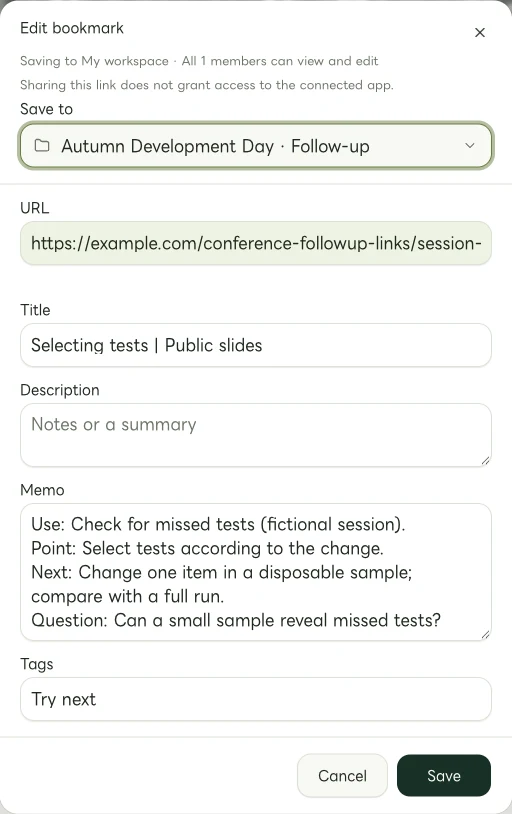
Actual Web edit dialog showing a fictional example.com link. The memo and tags are examples of manually entered information.
Pick the smallest experiment for next week
Suppose the interface idea needs a discussion, the operations idea needs further review, and the communication idea belongs in the next team meeting. The testing sample may be the one thing you can investigate on your own.
Add a “Try next” tag to that reference and leave the others available for later. Tags are markers you maintain yourself. Put any actual deadline in your usual calendar or task tool; keep the supporting resources and notes in linqlo.
After trying it, add three short observations: what you changed, what you learned, and what remains unclear. Even an unsuccessful attempt is useful if you note which assumption differed from the talk. Remove or change the tag manually when you finish.
Know where to look for unpublished materials
Check the organizer’s announcement or the publication location given by the speaker. Keep attendee-only materials out of public collections and do not redistribute them without permission. Saving a URL does not grant access or permission to share the material.
If you want to keep exploring while you wait, add a relevant public official document as a separate reference. Label it “Additional reading I found,” rather than implying that the speaker recommended it.
For your next event, aim for three things: the session name, a public link you can return to, and your own question. That is enough to turn a remembered idea into something you can investigate.
Related guides
Put the guide into practice.
Create a free account to get started. No credit card needed.
Start organizing for free